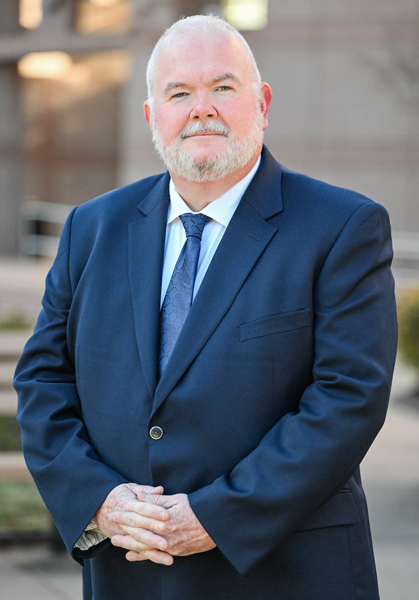
James Bailey, a Republican, is running for the Cabarrus County Commission in the Nov. 3 general election. Three seats are open, and voters will choose up to three candidates.
Bailey is one of seven candidates certified for the ballot. The others are Dan Redding (Democratic), Ian Patrick (Republican), Ingrid Nurse (Democratic), Kristel Swayze (Republican), Phil Henry (Democratic) and Thomas B. Hill (Libertarian).
Asked why he is running, Bailey said in our candidate questionnaire: "I am seeking this office to remove all of the partisanship from our governing bodies. In all levels of government, politics have superseded good governance. I want to work on delivering good outcomes by listening to our citizens and using tax dollars wisely to provide the best services to our residents."
Candidate information
Party: Republican
Family: "I am married with two children and five grandchildren."
Education:
M.S. Criminal Justice Administration - East Carolina UniversityGraduate Certificate, Criminal Justice Education - East Carolina UniversityB.S. Criminal Justice - Western Carolina University (Magna Cum Laude) >I am also a graduate of the Public/Non-Profit Leadership Academy at UNCC
Previous elected or appointed office: "None."
Family in government: "I have a daughter-in-law that is a school teacher in Cabarrus County Schools."
Experience and public service
Bailey said in our questionnaire: "I am a retired Chief Deputy (2023) with the Cabarrus County Sheriff's Office. I ran the day to day operations of the office, including creating and maintaining our budget. After retirement, I took a year off but found I did not like being idle. In June of 2024, I accepted a position as the Assistant Director of Campus Health, Safety, and Security at Rowan-Cabarrus Community College where I still work."
According to The Cabarrus Compass, Bailey was born in West Virginia and moved to Kannapolis in 1983, according to the candidate. He attended Winecoff Elementary, NW Cabarrus Middle School and NW Cabarrus High School. He started at the Cabarrus County Sheriff's Office on March 27, 1995, and retired May 1, 2023, after 29 years of service, according to Bailey.
On the issues
Budget experience: Asked how his sheriff's office budget work would inform his approach to the county budget, Bailey said: "When designing a budget, I would have stakeholders in the room discussing why various adjustments were made … A commissioner should handle the county budget the same way. You should get key stakeholder input and include the public as soon as feasible so that the process is as transparent as possible."
School funding: Asked how he would fund school construction as enrollment grows, Bailey said: "Approving the general obligation bond (GO) is paramount. Without adequate financing options, the tax burden only increases for our residents. If we can promote business investment into our county, that will help with increasing assessed values thus providing additional funding streams so that we can pay for the upcoming school needs."
A general obligation bond is a municipal bond backed by the county's taxing power rather than revenue from a specific project.
Key differences: Asked what sets him apart from other candidates, Bailey said: "My experience working in governmental budgets and my ability to work with diverse populations gives me a major advantage over my opponents."
Past accomplishments: Bailey said: "I managed a 400+ employee agency where I was the budget manager and the HR manager. I was also on Patrol for 21 years where I saw people at their lowest moments. I can handle any situations I may face."
Best advice received: Bailey said: "My grandfather told me as a child that it is hard to lie about someone when you are looking them in the eye. Basically telling me to have face to face dealings with others."
The Cabarrus County Commission oversees the county budget, sets the property tax rate, funds public schools and manages growth and development across the county.
Candidate responses were collected through a Concord-Harrisburg Herald questionnaire. Answers are presented in the candidate's own words and have not been edited for grammar or style.