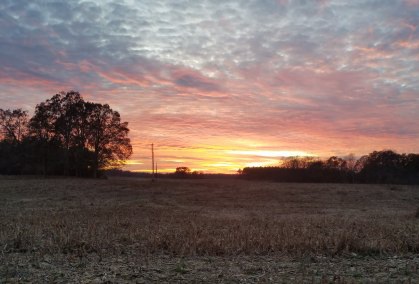
Eighty-four acres of family farmland along the Rocky River in Cabarrus County will stay undeveloped permanently, Three Rivers Land Trust announced Thursday, Oct. 1.
The conservation easement protects nearly a mile of Rocky River shoreline on a working farm and forest, first reported by the Salisbury Post. The North Carolina General Assembly funded the project through the North Carolina Land and Water Fund, though the specific grant amount was not disclosed.
The deal carries weight locally. Cabarrus County has lost more than 2,500 acres of farmland, according to USDA Farm Census figures cited in the land trust's release. Three Rivers Land Trust described the county as one of the fastest-developing in the state.
Emily Callicutt, the land trust's director of conservation, said the easement helps protect drinking water far beyond the property line.
"Conserving land along the Rocky River will help contribute to the protection of water quality in the Yadkin-Pee Dee River Basin, which serves as a drinking water source for over 1 million people," Callicutt said.
The river itself is unusual. It runs more than 95 miles from Iredell County to Anson County, is completely undammed and supports habitat for more than 50 bird species, according to the land trust.
Under the easement, the landowner family retains private ownership of the property. The family said in the land trust's release that the land holds deep personal meaning and that the easement lets them protect its agricultural heritage for future generations. Conservation easements are a legal tool that restricts future development on a property while keeping it in private hands.
The Land and Water Fund, created by the General Assembly in 1996 and formerly known as the Clean Water Management Trust Fund, has conserved more than half a million acres and protected or restored 3,000 miles of streams and rivers statewide. Three Rivers Land Trust, which operates across 15 counties in the central Piedmont and Sandhills, has conserved 21,582 farm acres across its service area, according to its website.
The 84-acre parcel adds to that total along a stretch of the Yadkin-Pee Dee River Basin that supplies drinking water to more than 1 million people downstream.